SIEM Pricing

SIEM pricing in 2026: what small IT teams actually pay

By Arden Security • April 14, 2026 • 7 min read

If you manage a Windows environment with 20 to 200 machines and you've ever tried to price out a SIEM, you already know the feeling. The "contact sales" button. The per-GB ingestion math. The realization that monitoring your own security logs somehow costs more than the servers generating them.

We built Arden because we hit the same wall. This post breaks down what the major SIEMs actually cost for a small Windows environment, why the pricing models don't work for small teams, and what a flat-rate alternative looks like.

The per-GB trap

Most enterprise SIEMs charge by data volume — dollars per gigabyte of logs ingested per day. On paper, that sounds reasonable. In practice, it's the model most likely to punish you for doing the right thing.

A single Windows endpoint generating Security, System, and PowerShell logs produces roughly 50–200 MB of event log data per day, depending on activity. A domain controller can produce over 1 GB. So a modest 50-machine Windows environment with a couple of DCs is looking at 5–15 GB per day before you've even tuned anything.

That's where the math gets uncomfortable. You start disabling log categories to reduce volume. You stop collecting PowerShell transcripts because they're "too expensive." You skip monitoring workstations entirely and only ingest servers. Suddenly the SIEM is making your security worse, not better, because you can't afford to actually use it.

What the big SIEMs actually cost

Here's a realistic comparison for a 50-endpoint Windows environment with 10 GB/day of log ingestion. These numbers are based on publicly available pricing and common deployment scenarios as of early 2026.

Platform Pricing Model Est. Monthly Cost Annual Cost
Splunk Enterprise Per GB/day ingestion $1,500 – $4,000 $18,000 – $48,000
IBM QRadar Per EPS (events/sec) $800 – $2,500 $10,000 – $30,000
Microsoft Sentinel Per GB ingested $700 – $2,000 $8,400 – $24,000
Elastic SIEM Self-hosted (infra cost) $300 – $1,200 $3,600 – $14,400
Arden Security Flat monthly rate Flat rate Flat rate

The ranges are wide because enterprise SIEM pricing depends on commitment terms, negotiation, reserved capacity, and how aggressively you filter logs before ingestion. But the floor is clear: you're looking at thousands per year minimum for any of the established platforms, even at modest scale.

Why per-GB doesn't work for small teams

The per-GB model was designed for enterprises that have a security team dedicated to tuning ingestion pipelines. They have engineers who build parsing rules, filter noisy log sources, and optimize storage tiers. They can afford to spend a week configuring a Splunk forwarder to drop irrelevant events before they hit the index.

If you're a two-person IT team managing 50 Windows machines, you don't have that luxury. You need to turn something on and get value immediately. Per-GB pricing creates a perverse incentive: the more thoroughly you monitor, the more you pay. That's backwards.

The flat-rate alternative

Arden takes a different approach. Instead of billing by data volume, you pay a flat monthly rate based on how many endpoints you're monitoring. Monitor 10 machines or 200 — the price is predictable and doesn't penalize you for enabling audit policies or collecting PowerShell logs.

There are a few architectural reasons this works. Arden doesn't ingest logs into a cloud backend. It runs on your network, reads Windows event logs directly (via the local API or remote agent), and processes everything locally. No per-GB cloud storage, no indexing infrastructure, no data egress charges. The heavy lifting — parsing, detection, alerting — happens on hardware you already own.

That means you can enable every audit policy your compliance framework requires, collect every PowerShell script block, monitor every workstation and server, and your bill doesn't change. You're paying for detection coverage, not data volume.

What you get for a flat rate

Arden isn't a stripped-down dashboard. The detection engine covers the full MITRE ATT&CK kill chain with rules for lateral movement (PsExec, pass-the-hash, WMI, DCOM), credential theft (Kerberoasting, DCSync, LSASS access), persistence (services, scheduled tasks, registry run keys), and privilege escalation (token manipulation, group changes, SID history injection).

The Network edition deploys agents from a single console, groups alerts across all your endpoints so you can see the same attack hitting multiple machines at once, and sends email or webhook notifications the moment a critical alert fires. You also get one-click PDF compliance reports if you're running the compliance module, Sigma rule import for custom detections, and automatic log archiving so your storage stays manageable.

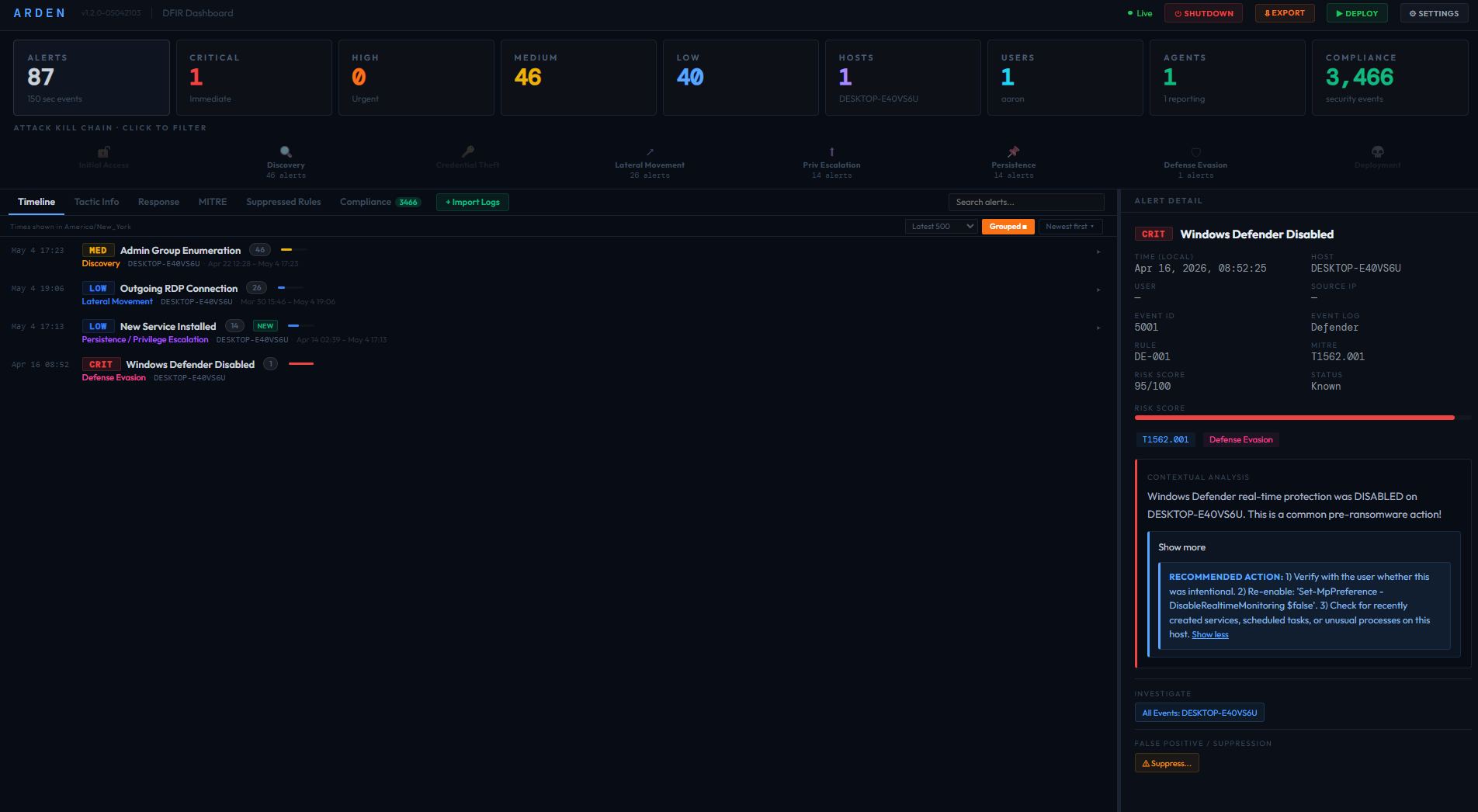
All of that runs as a single portable executable. No Java, no Elasticsearch, no Docker, no cloud account. Here's what the dashboard looks like with real alert data from a 50-endpoint deployment:

Arden Security — Dashboard localhost:8080
1,247
Total Alerts
3
Critical
17
High
89
Medium
52
Hosts
198K
Events
Timeline
Analysis
MITRE
Compliance
Agents
Apr 28 14:32
CRIT LSASS Memory Access Detected 3 endpoints
Credential Access · DC01, SRV-FILE02, WS-ADMIN · [email protected]
Apr 28 14:28
HIGH PsExec Service Installation
Lateral Movement · SRV-FILE02 · T1021.002
Apr 28 14:15
HIGH Kerberoasting Activity
Credential Access · DC01 · svc_backup · T1558.003
Apr 28 13:51
MED Admin Group Enumeration 12 endpoints
Discovery · 12 endpoints affected · Mar 28 – Apr 28
Apr 28 13:44
MED Suspicious Scheduled Task Created
Persistence · SRV-APP01 · SYSTEM · T1053.005

Arden's real-time dashboard showing cross-endpoint alert grouping, MITRE ATT&CK mapping, and severity prioritization across a 52-host deployment.

You don't have to monitor everything

There's a pragmatic middle ground that most SIEM vendors don't talk about because it doesn't maximize their ingestion revenue: just monitor your high-value servers.

Threat actors almost always target servers. Domain controllers are the crown jewels — if an attacker gets DC access, they own the entire domain. File servers, Exchange servers, SQL servers, and admin workstations are the next tier. In most real-world attack chains, the attacker moves from an initial foothold on a workstation to one of these high-value targets as fast as possible. The meaningful detection events — credential theft, lateral movement, privilege escalation, persistence — happen on the servers.

That means running Arden on just your domain controllers and a handful of critical servers can catch the vast majority of serious attacks. You're monitoring the places attackers have to touch to achieve their objectives. A single Arden instance on your DC, watching for Kerberoasting, DCSync, pass-the-hash, service installation, and suspicious scheduled tasks, is infinitely more detection coverage than monitoring nothing at all.

This approach also saves on network bandwidth and deployment complexity. Instead of deploying agents to every workstation, you deploy to 3–5 critical servers and get immediate, high-signal detection coverage. If budget allows later, you can expand to workstations for broader visibility. But starting with servers gives you the best return on effort.

When Arden isn't the right fit

If you need to ingest Linux syslogs, cloud audit trails (AWS CloudTrail, Azure AD), or network flow data, Arden isn't the tool. It's purpose-built for Windows event logs. If you're a 500-person company with a dedicated SOC and you need a platform that correlates across dozens of data sources, an enterprise SIEM is the right investment.

But if you're managing a Windows environment, your current security monitoring is Event Viewer, and you need real detection coverage at a price that doesn't require board approval — that's exactly the gap Arden fills.

For a deeper look at the detection capabilities, check out our detection engine overview or read how Arden detects lateral movement without a SOC.

Flat-rate security monitoring for Windows.

Join the early access list and get notified when Arden launches.

Join Early Access